Tucson International Airport adds service that helps visually impaired navigate facility

Bravo Tucson International Airport! Way to be an industry leader and support your visually impaired community with this new service!
from Tucson.com
Blind and low-vision passengers will get free help navigating Tucson International Airport with a system that connects them via mobile phone networks to a personal airport guide.
What do drivers do when encountering a blind pedestrian?
Wow the Louisiana white cane law takes no prisoners when it comes to laying out how drivers should deal with a visually impaired person crossing the street!
Inspiring story of a blind baker getting his dream job.
While this story is not about travel specifically, I feel a connection to the hero of this story because he lost his sight in 2005 in a car accident like I did. Traumatic and sudden sight loss has been equated to losing a limb. At least if you Glaucoma of other similar disease that gradually takes you vision, at least you have time to come to grips with the loss.
https://www.nzherald.co.nz/nz/news/article.cfm?c_id=1&objectid=12199991
life-changing device for the visually impaired gets an upgrade.
The MyEye 2 is a small device which uses AI to scan and read objects in front of the user. It features multiple languages and is small enough to clip on a pair of glasses.
University of Iowa professor creates app with help from Microsoft
University of Iowa professor Kyle Rector has created an app which helps users stay in their lane while walking on a track. This is a difficult task even for those with good orientation and mobility skills. I can see this technology being used for great thigns in the future.
University of South Florida making navigation easier.
USF is refining 3d printing techniques to create tactile maps of the school for the visually impaired.
Guide dog helps visually impaired man navigate Spring Festival rush
Little Q, a golden retriever in a red vest, embarked on a 1,300-kilometer journey with his master during the Spring Festival travel rush.
“Little Q is my eyes, and I can rest assured with him,” said Su Bo, the dog’s owner, who is visually impaired.
http://www.ecns.cn/news/2019-01-31/detail-ifzeerre7964768.shtml
eSight eyeglasses use innovative technology to let the visually impaired see
Leveraging multiple leading-edge technologies, Toronto-based tech firm eSight Corp. has designed and developed a set electronic glasses that let the visually impaired see. Representing the only clinically-validated device on the market that enables those living with vision loss to see, the eSight glasses are worn comfortably like a normal pair of glasses, allowing the user to be mobile and engage in virtually any activity of daily living.
Bird Box Challenge or parody of disabilities for profit?

Social phenomenon or fads have been with us likely forever and can arise from many different areas of influence. In the 1950’s, millions of teens took part in the hula hoop craze. Then, in the 1970’s and 80’s, we saw more examples of fads like the pet rock and the Rubik’s cube. Let’s also not forget about the Slinky, a springy toy introduced in the 1940’s that would walk down stairs seemingly by itself (alone or in pairs.). Fads tend to eventually fade in popularity, but their effects remain ingrained in social folklore proportional to the extent they last, and their social impact. Social media outlets like Twitter and YouTube have become an integral cog in the machine that spreads the popularity of contemporary fads. The Bird Box challenge is the latest phenomenon to burn up today’s social media pages.
Fads in recent years
Today, we continue the fine tradition of fads. Some are like the ice bucket challenge of 2014, which ended up garnering worldwide attention and raised $15.6 million for the ALS Association to research Lou Gehrig’s disease. Other fads are not quite so benign: for example, the cinnamon challenge which started in 2001. Participants challenged themselves to eat a heaping tablespoon of cinnamon without choking. Things escalated quickly, spawning unhealthy challenges like the bath salts challenge and more recently the Tide Pod challenge, where YouTube stars and hopefuls ingest Tide detergent pods. All too often, the participants end up in the hospital, and some have even met an early demise from participating in these ill-advised extreme challenges.
According to data from YouTube, over 300 hours of video are uploaded to the platform every minute as of its January 2019 reporting. With 18 to 49-year-old viewers watching nearly 5 billion videos a day on the platform, it is easy to see how content can get lost in the deluge of uploads. In an ongoing struggle to stay relevant, content creators lean towards more extreme (or unique) themes in their creation methods. This is all in the hopes of going viral and hopefully rise to the top of a very busy pile of videos. Each minute of video watched on a channel leads to more impressions, ad views, and chance of revenue. It is with this in mind that we are seeing a shift from the short format (just showing the challenge) to longer videos which feature the results of the challenge – referred to as aftermath videos. YouTube celebrity Chris Schewe (Shoenice) made a multitude of videos where he would drink an entire bottle of alcohol and then record the aftermath for his fan’s enjoyment. Shoenice was eventually banned from YouTube, as his videos were spawning copycat challenges, and young children were reportedly getting hurt from ingesting large quantities of alcohol. Since that time, many other YouTube celebrities continue to create extreme videos (L.A. Beast, Furious Pete) showcasing extreme eating and the eventual aftermath, which usually includes vomiting.
Bird Box
In December 2018, Netflix released their original production Bird Box, starring Sandra Bullock – spawning the latest fad, The Bird Box Challenge. This challenge ranges from the safe to the insane. In the movie, the characters are haunted by mysterious bird-like creatures who cause anyone that looks at them to go insane and kill themselves. In the movie, to stay safe, the characters wear blindfolds while outside and try to survive their day-to-day lives without seeing. This has led to YouTube videos where people don blindfolds and try to brush their teeth, eat, and in one case drive a car.
I am almost blind, with only a small bit of light perception and no detail in my tiny field of vision. I decided to watch the movie, make an informed decision about the story and give my opinions on the Bird Box Challenge. I live my life with a visual field very similar to the way the characters’ vision is portrayed in the movie (with the blindfolds on).
Before watching the movie, I read several reviews that categorized it as a horror film. I would consider this a cliché’-riddled thriller. I love horror movies, and while this feature does contain some mild nudity, violence, and vulgar language, the content isn’t any scarier than one of the gorier episodes of CSI. The first thing I thought of when I started this movie was the 2018 Thriller A Quiet Place. For those who have not seen that movie, the characters are haunted by bird-like creatures who attack if they hear noises above a whisper. The characters survive their day-to-day lives by using sign language and being wary of where they step. I won’t go into spoilers about the hero of the movie, but suffice to say, if you have seen both movies you will notice glaring similarities in the plots.
Portrayal of being sightless
Before I delve too deeply into the way blindness was portrayed in Bird Box, I need to be clear that while I am visually impaired and advocate for the rights of the partially sighted, I was not offended by this movie. I was also not bothered by the way blindness was portrayed in the feature. I was, however, confused about the tools the characters used in the movie for navigating their environment. In most scenes, the characters chose to use fishing reels, using the line to lead them back to a specific location. Realistically, people who are sight-impaired use time-distance estimation when traveling and often count their steps. The glaring absence of objects used as “white canes” is also confusing to me. Even the fishing poles the characters used would be a perfect improvised cane, lending a reasonable amount of tactile feedback and flexibility when navigating the environment. These issues aside (and yes, I realize this is a movie and for entertainment and not intended to be reality) I liked the movie and thought it was worth watching. It will not go down as a stellar achievement in film history, but it was a good watch. If you liked A Quiet Place you should find Bird Box equally entertaining.
The way the characters dealt with their lack of sight in the beginning of the movie was accurate, but the scenes that fast-forwarded five years showed little progression in the character’s skill of completing tasks while visually impaired. The children in the movie, who grew up with the blindfolds should have been significantly more aware of their surroundings, and very capable of navigating their environment effectively. Again, I will reiterate I fully realize this is a movie and production decisions were made for entertainment over reality.
Putting yourself in other’s shoes
In Bird Box, the characters drive, defend themselves, and travel around their environment outside while blind. I can see how the Bird Box challenge grew from the tension and difficulty the characters experience in the movie while trying to survive without sight. However, this is a movie, and deciding to create YouTube videos that (in many cases) poke fun at and make light of a disability for the purposes of making money should be reconsidered. I’m not easily offended, but I know lots of visually impaired people who take their disability a lot more seriously than I do. Perhaps we should consider a more constructive way to put ourselves in other’s shoes.
Why not take a Saturday and really wear the blindfold all day? Spend the day trying to find your way around the house, cook breakfast for yourself, find the television remote and take the dog outside without being able to see. Take the challenge of really putting yourself in another’s shoes. If that is too big of a commitment for you, try putting that blindfold on and watching a movie you haven’t seen before with only the audio descriptions on. This article isn’t intended attack anyone for doing the Bird Box challenge: this is meant to shed light on the fact that people are making money off parodying disabilities.
Learn about visual impairments
One of the best ways to learn about visual impairments, and how they affect a person’s life is to talk to a person with limited vision. Many with low vision (myself included) are very willing to talk about vision loss and how it affects your life. You can always DM or email me – all the pertinent information to reach me can be found in my contact links at the end of this article. There are also numerous resources to learn about visual impairment, here are a few:
Lighthouse for the Blind and Visually Impaired
Royal National Institute of Blind People
National Federation of the Blind
Moving on
Like any fad, the Bird Box challenge will fade, and if the Tide Pods, Bath Salts and Cinnamon challenge are any indicator, it will not be long before the next extreme challenge takes its place. In the meantime, why not research vision loss and how people live with visual impairments.
I love to hear from my readers! Feel free to contact me on any of my websites or on social media.
My Photography site: http://www.tahquechi.com/
My Bodyscapes project: http://www.bodyscapes.photography/
My travel site: https://www.blindtravels.com/
Twitter and Instagram: @nedskee

Guide Dog Files part 5

As I wind up this story recounting my experiences learning to work with my Guide Dog Fauna, I extend my appreciation to all who have followed this story, and hope that you will continue to follow our adventures here on BlindTravel.com. We pick up the story at the beginning of the second week of training…
A new week, and new adventures
After a well-deserved day off, we started fresh and new Monday morning. The location we would use for this adventure was the very busy Chestnut street in downtown San Francisco. The students and instructors setup “camp” in a coffee shop for the morning training route. This would be the most difficult routes to date, with the general public out and about in full force everywhere. The big city didn’t disappoint as this was indeed the most challenging travels we had encountered to date. For a Guide Dog team, the general public present a myriad of possible issues when venturing down any given street. We ran the gauntlet, encountering and deftly avoiding small barking dogs, people not paying attention to where they were walking, and inattentive parents, letting their children run right up to a working guide dog team.
Because of lack of education on the subject, the general public don’t understand how important it is to not distract the guide dog when he or she is on harness and working. The guide is working to keep their teammate safe and lead them through potentially dangerous situations. A dog or unattended child running up and interacting with the guide dog can potentially distract and veer the guide off their line and into traffic. This can be incredibly dangerous for the team.
I live in a suburb north of Denver, and don’t often find myself in a downtown area, so the sights, smells and distractions of the downtown environment can be a bit daunting for those who don’t often encounter them. These locations are toughest on the dogs, because they need to determine how to lead their handler on a safe and reasonable line through the city blocks often when there is little room to maneuver safely. The dogs do this while negotiating a gauntlet of distracting smells, people and other dogs. It makes sense that after the long travels through the streets of San Francisco, poor Fauna was completely drained and sleeping like a log on the way back to campus. The previous week’s work and experiences and the distractions we encountered helped to hone our teamwork and skillset needed for downtown travel. If you can travel safely through and around Fisherman’s Wharf with all those obstructions, heading down to Starbucks on a reasonably smooth path is comparatively easy as pie.
Fauna faces her arch enemy
With the chaos and unpredictable big city behind us, we traveled back to the mall for some more practice time on the escalators, and generally wandering the mall. Fauna got all but one of the escalators correct and deftly led me through the sales kiosks and displays in the beauty department. We concluded our mall training with some time working on targeting empty chairs and headed to the staging area so the other member of our class could work with our trainer.
We had setup camp in front of the local movie theaters. The smell of fresh hot popcorn and excitement of children running around provided a ton of different distractions for Fauna. After my route through the mall, I decided it was time to challenge Fauna, so we headed to grab some popcorn to bring back to my room. I knew it was going to be difficult for my young guide dog. We moved into position at the end of the snack food line, and I ordered my small popcorn. There was about half a bag of popcorn on the floor that we had to wade through to get to the cashier. Before that though, we encountered about fifteen children all milling around, running up to the counters, ordering ice cream and popcorn – and of course resisting the urge (some better than others) to engage Fauna. During their training, the guide dog is trained to refuse food, whether it be from the public, or off the floor. Scavenging is not only looked down upon, but not acceptable behavior for a guide. With super-dog restraint, Fauna confidently walked through the milling and running children, all while ignoring the fresh popcorn all over the floor at her feet. With great resolve, she led me up to the cashier, with popcorn in hand to pay my bill. Little did I know that the actual procurement of the popcorn would not be the most difficult part of this training operation. We found our seats in the rendezvous area, and I began to eat the popcorn off the top of the mounded bag so that it would be easy to close for the ride back to campus. As I munched the hot buttery corn, Fauna (who was sitting under my chair between my legs) started to breath very deeply, almost panting. I felt down and realized there was a serious problem! Somewhere along the way, a piece of popcorn must have fallen out of my grasp, bounced off Fauna’s head and landed right in front of her at her feet. I reached down to grasp the popcorn piece and realized the it was floating in a pool of slobber, and she had been breathing deeply in an effort to suck the popcorn closer to her waiting mouth. She looked up at me with drool running down her chin, and unceremoniously wiped the entirety of the streaming slobber on my bare leg. A small price to pay for getting such a big win for this young guide dog.
Meeting the large animals
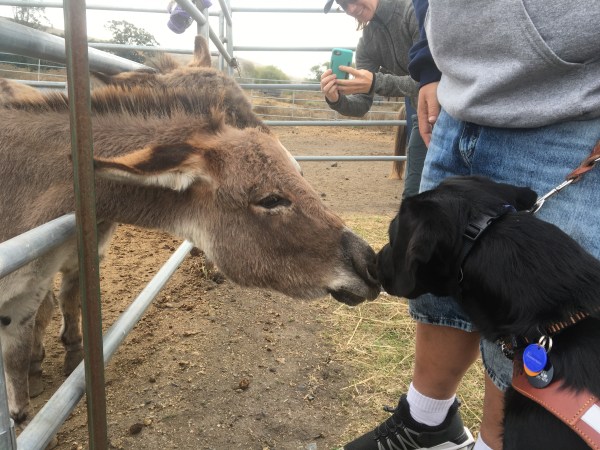
Guide Dogs for the Blind do everything in their power to set their students up for success after they complete their training and head off into the world. This includes the trainers tailoring the training to focus more time on locations that are appropriate for the team. On this day, my teammate was heading to a local farm to give her dog some experiences with large animals. Since I didn’t have a specific itinerary, I decided to tag along and give Fauna some new experiences as well.
We pulled into the farm parking and got the dogs out of the van. Immediately both dogs were agitated from the wandering flock of chickens outside the van. We walked through the farm exploring each paddock, where the dogs met cows, potbelly pigs, miniature horses and donkeys. At first, Fauna was very hesitant to interact in any way with these large animals. It was not until I broke the ice and patted the cow in front of her that she started to feel at ease. Fauna needs reassurance that things are going to be ok – she is incredibly trusting of her handler. I think this is one of the reasons she is so personable and watches her people so closely. With the ice broken, Fauna tentatively sniffed and began to calmly interact with the cows and other large animals. With her comfort growing, I began to wonder if the puppy raisers had ever introduced her to larger animals.
The day ended with a walk through a local Target store. This was an amazing trip, as I had never shopped with a guide dog. Walking through the store with Fauna on follow command (following my instructor through the store) was a freeing and wonderful feeling. It was great to be able to traverse the store easily without running into or banging things with my cane. We learned about targeting a specific area in a store, I learned how Fauna will be able to find specific things in my local store. We used patterning, back chaining and hand targeting for specific items that need to be found repeatedly.
Winding up the two-week training
The last few days of my guide dog training focused on specifics for my day-to-day life. We went to a local park and hiked, which I appreciated the experience, since I plan to spend more time in Rocky Mountain National Park. We traveled several different widths of trails, some with overhead objects to negotiate. We also visited a local residential area with a nice waking path around a lake. This was like the suburb that I live in, as it doesn’t have formal right and left turns, rather meandering paths through the park and houses in the area. This gave Fauna and I the opportunity to hone what they call moving turns.
Talking with the puppy raiders
Upon returning from a trip to the hot tub located in the Guide Dogs for the Blind facility, I received a call from the retired couple that raised Fauna from a puppy to the age of 15 months. It was at that time that she began her formal guide dog training. It was a pleasure talking with the puppy raisers, and we spent a lot of time talking about Fauna as a young girl. Fauna’s puppy raisers had 14 puppies prior to getting Fauna, and as their 15th puppy, she would be their last. I cannot imagine how difficult it would be for me to give up a puppy after raising it for 15 months. Being a puppy raiser means having a huge heart and offering a loving home to an animal which will someday help keep someone safe. It is difficult for me to put into words the gratitude I have for the people that raised Fauna to be the wonderful loving dog she is. After a short time with her I can not imagine how hard it would be to give her up. I was sad to find out that the puppy raisers would not be able to make it to graduation day.
Meeting Fauna’s Trainer
The day before graduation was an emotional one. The reality that this group of amazing students who had grown so fond of each other so quickly would have to say farewell the following day left the building with a feeling of sadness in the air. After lunch, I met with the trainer who had worked with Fauna during her guide dog training. It had been a few weeks since Fauna had seen her, so she immediately ran to her and spent then entire time we talked pawing at her and laying close. I was surprised to find out that it took a while for Fauna to warm up to her emotionally during training. I was also shocked that she was not aware that Fauna loves to hold your hand when she is hanging out with you. I of course told her I appreciated the time and effort she put into training Fauna, and that I could not believe how attentive she was. I asked if she had ever seen snow and she said she did not think so. The weather report said that we would be heading home to snow on the ground, which I figured would be interesting. The training staff at Guide Dogs for the Blind all have incredibly huge hearts. It shows that they care deeply for the dogs they are working with. The care and detail that they use when training both the client and the dog really shows in the end result.
Graduation Day
With two weeks of work and many miles walked behind us we all prepared for graduation day. Friends and family are encouraged to attend graduation, and the Guide Dogs for the Blind campus is open to the public. Puppy raisers arrive a couple hours before the graduation ceremony, and it’s a great time to get to know each other and let the new guide graduates visit with the family that raised them. Emotions run high, there is a ton of crying and laughing. Graduation day also marks the first time that the teams are allowed to leave the campus on their own. The two-week course is intensive and detailed so other than expected anxiety of venturing out on your own, students feel comfortable in the lessons they have learned. At this point, responsibility for the guides is signed over to the handler and you are introduced to the robust alumni support system. Guide Dogs for the Blind offer a hotline of sorts with support staff that can answer questions and offer support about dog care, access issues and even veterinary care concerns. This support even extends to emotional support when a guide gets sick or it comes time for a guide to retire from duty.
The chaos and emotion surrounding the graduation ceremony is something to behold. We laughed, we cried and we were all finally on our way home with our new teammates.
Final thoughts
I waited a very long time before I decided to apply for my guide dog, and as I write this, Fauna and I have been a team for a couple months now. The thing that stands out in my mind every day as Fauna guides me safely around any given situation is why did I wait so long to do this. I appreciate everyone at Guide Dogs for the Blind for their time, companionship, mentorship and professional demeanor throughout the entire process of applying for and training with my new guide dog. I appreciate the puppy raisers for their time, love and hard work raising Fauna to be a loving, attentive teammate. I appreciate the other members of my Guide Dogs class, you are amazing people who I was privileged to share laughs, tears and potty times with. Lastly, I appreciate Danielle, my instructor who deserves some sort of purple heart, or at least a congressional medal of honor after having to put up with me for two weeks.
After completing the guide dog program and working with a guide for a while now, I believe it should be the goal of all guide dog teams to educate the general public about the role of the guide dog, and the importance of not distracting them when they are doing their job. Many feel that the ownness of this education should be on schools or other institutions, but it is the guide dog team that is on the “front line” with the public, and directly interacting with them on a daily basis. Granted, sometimes a team may not be able to stop and spend time with every inquisitive member of the public, but whenever possible I personally take the time to explain how the dog works with me to keep me safe in any given situation. People find this fascinating and I pride myself on being a source of information about the Guide Dogs for the Blind program and organization for those who have not had interactions with a guide dog team before.
I also firmly believe that all service animal users need to promote and advocate for their rights, and not rely on others to educate the public and government officials on the important role service animals play in society. There also needs to be clearly worded rules about the difference between a service animal that performs a task for its teammate, and someone who has a pet they want to bring with them in the guise of a service animal. Buying a service animal vest off the internet and slapping it on your little puppy with no training because you can’t bear to leave it at home doesn’t help the acceptance of genuine service animals.
It is with all this in mind that I am announcing a new body of photographic work featuring my guide dog Fauna. This work will make its debut at Access Gallery at 909 Santa Fe in Denver Co. on March 1, 2019. The work’s purpose is to educate the general public about the legitimate use of service animals in the travel and hospitality industry. I would like to extend an invitation to all who wish to come and meet Fauna and I on March 1. More details will be forthcoming as schedules and times are firmed up.
Thank you to all who have followed my story, I appreciate your time and the kind words you have shared with me about this story. I hope that you will continue to read about our adventures because we are only getting started.
Website: http://www.tahquechi.com/
Charity Work: http://www.bodyscapes.photography/
Travel & Review Site: https://www.blindtravels.com/
Instagram and Twitter: @nedskee
